
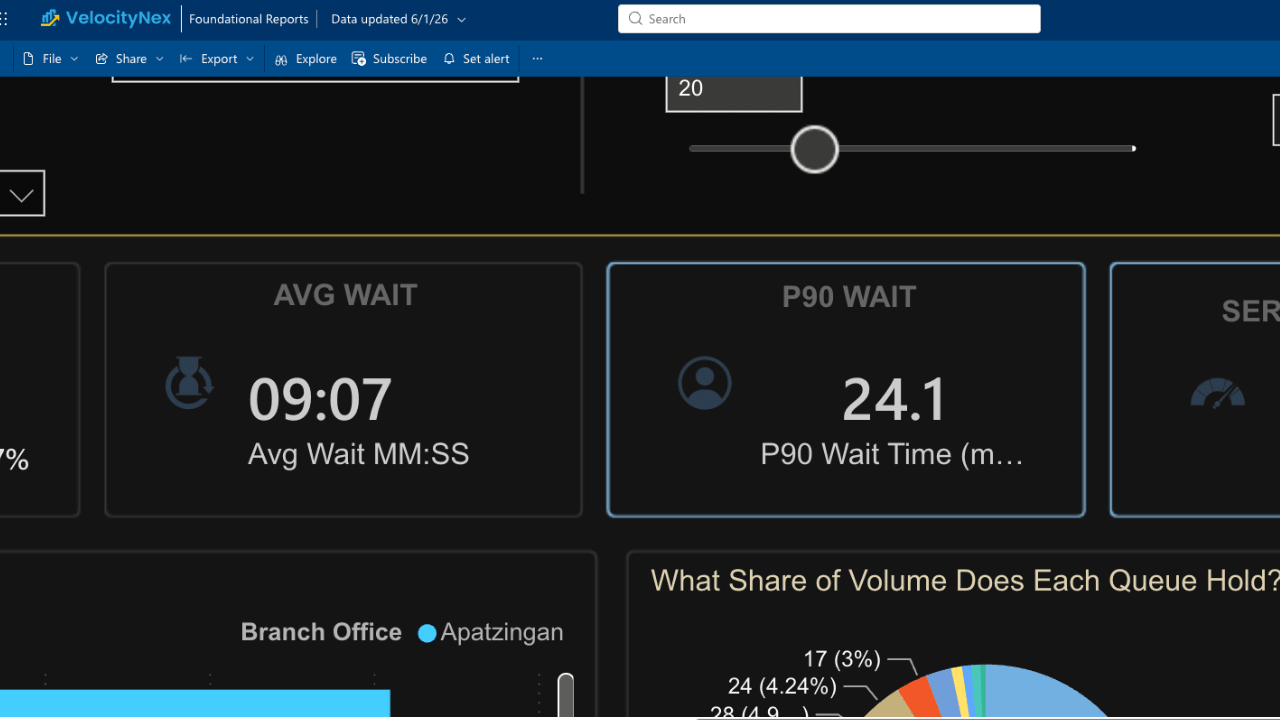
Average wait time tells you what happened yesterday. P90 tells you what your worst-served constituents actually experienced — and whether your operation is meeting a defensible service standard.
P90 wait time is the point below which 90 percent of wait times fall over a defined period. It is the standard metric used in government service agreements, healthcare benchmarks, and contact center SLAs to measure service quality. It is not a new concept. Most queue management platforms have been recording the data needed to calculate it since implementation day. Standard canned reports do not surface it. That gap is where most operations teams are working blind.
A Question I Couldn't Answer
I used to cringe when customers asked me why we only reported average wait time.
I spent eight years as a Qmatic implementation and pre-sales engineer. The question came up more than once. A director or operations manager would look at the report, look at me, and ask: why is this a single average? Why can't we see what people actually experienced?
The honest answer is that reported wait times in most queue systems are estimates, not direct measurements. They're derived from available counters, queue depth, and expected transaction durations, a projection of what the wait should be, not a record of what it was. The math tends to approximate the experience of someone near the front of the line. It doesn't represent the person in the middle, and it doesn't represent the person who just walked in.
The customer who asked me that question never got a satisfying answer. The right metric to answer it wasn't part of the standard reporting stack.
What I know now that I didn't know then is that there is a metric better suited for what that director was actually asking. It does not give you the actual wait time of each individual either. Nothing pre-calculated can, because queues shift by the minute. But it is computed from something fundamentally different: real, completed transaction records. Every visit that happened, start to finish, measured after the fact.
That metric is P90. And the data your queue system has been recording since go-live is exactly what you need to calculate it.
What P90 Actually Means
P90 stands for the 90th percentile of wait times over a defined period.
In plain terms: if your P90 wait time for a Tuesday morning is 34 minutes, that means 90 percent of constituents who arrived during that window waited 34 minutes or less. The remaining 10 percent waited longer than that.
That last group is where complaints come from. It is where the constituent who waited 52 minutes while the posted estimate said 20 minutes comes from. It is where the supervisor escalation, the service director inquiry, and the front-desk confrontation come from.
Average wait time does not show you that group exists at all. It folds them into a number that makes the operation look more consistent than it is.
P90 isolates them. It gives you a threshold, a line in the data, that defines when your operation crosses from acceptable into a territory that produces negative constituent experiences.
Why This Is Different From the Average Your Reports Show
The average wait time shown on most queue system reports is not calculated from completed visit records after the fact. It is a modeled estimate, calculated in real time from queue variables: how many counters are active, how many people are waiting, and what the expected transaction time is for the service type in that queue.
That is a reasonable approach for displaying an estimated wait to a constituent who just arrived. It is not the right tool for measuring service quality after the day is over.
P90, calculated from raw transaction records, is computed from actual completed wait durations. Not estimates. Not models. The timestamp when a ticket was called minus the timestamp when it was issued, across every transaction in the period you are analyzing. That is a measurement of what happened, not a projection of what was expected.
The distinction matters because estimation and measurement answer different questions. An estimated average answers: what should the next person expect to wait? A P90 calculated from completed records answers: what did the people who waited the longest actually experience, and how often does that happen?
Those are not the same question. And in an operations review, the second one is the one your leadership is asking.
Why P90 Is the Standard in Every Other Industry
P90 and its close relative P95 did not originate in queue management. They come from fields where service delivery is contractually defined and needs to be defensible.
In telecommunications, SLA contracts specify that a technician must arrive within a defined window for at least 90 percent of service calls. Not all calls. 90 percent. The remaining 10 percent are tracked, reported on, and used to trigger remediation or penalties.
In contact center operations, the standard is often framed as a service level target: 80 percent of calls answered within 20 seconds, or 90 percent within 30. The percentage and threshold vary. The percentile logic does not.
In healthcare, the UK National Health Service tracks A&E wait time performance against a defined threshold and reports what percentage of patients are seen within it. That is percentile logic applied to a service queue.
In web performance, Google's Core Web Vitals measure page load experience at the 75th percentile of real user visits, specifically because averages mask the experience of slower users.
The pattern across every one of these industries is the same. Average performance metrics were replaced, or supplemented, by percentile metrics because averages could not answer the question that mattered: what is the worst-case experience that a significant portion of our users are having?
Government service operations have been slower to adopt this framing. The data to support it exists. The reporting infrastructure has not surfaced it.
What P90 Tells You That Average Wait Time Does Not
Consider a service center with the following wait time distribution across a three-hour morning block: most constituents wait between 8 and 18 minutes. A smaller group, arriving between 9:15 and 10:00, waits 35 to 50 minutes because two staff members were unavailable and the queue absorbed a backlog from a slow opening. The average wait time for the full block: 19 minutes. The P90 wait time for the same block: 44 minutes.
The average tells the operations manager the morning was within an acceptable range. The P90 tells them that roughly one in ten constituents had an experience more than twice what the operation appeared to deliver on paper.
Those are not the same conclusion. And they do not lead to the same staffing decision.
Average wait time suggests no action is needed. P90 reveals a specific window — 9:15 to 10:00 — where the operation was structurally unable to absorb demand. A shift overlap or an earlier opening would have directly reduced the number of constituents experiencing waits above 35 minutes.
That is an actionable finding. The average produces none.
The Data Is Already There
Most queue management platforms record individual transaction data at the record level. Arrival time, wait duration, service start, service end. The data exists. It has existed since implementation day.
P90 is a calculation performed on that raw data. It is not a new data type. It is not a feature that needs to be enabled. It is arithmetic applied to records your system has already collected.
The reason most operations teams are not looking at P90 is not a data problem. It is a reporting problem.
Standard canned reports are built to summarize. They aggregate individual records into averages, totals, and counts. Those formats are easy to read in a monthly operations briefing but collapse exactly the variance that makes percentile analysis useful. To get to P90, you need access to the underlying transaction records, not the summarized output.
Whether that access exists depends on your platform and your current licensing. That is a conversation worth having before assuming the data is out of reach.
The infrastructure exists. The data exists. The metric is standard. The gap is the reporting layer between them.
What This Looks Like in Practice
Once P90 is calculated and tracked, it changes the questions an operations manager can ask and answer with their data.
- Instead of "what was our average wait time this week," the question becomes "what was our P90 by hour on the days with the highest volume?"
- Instead of "were we within target," the question becomes "at what point in the day did our P90 cross the threshold that our service standard defines as unacceptable, and how long did it stay there?"
- Instead of justifying a staffing request with a rising average, an operations manager can show leadership a specific window where P90 spiked above 40 minutes for two consecutive hours, three days out of five, across a specific service type. That is a defensible, data-backed argument for a shift adjustment.
Average wait time cannot produce that argument. P90 can.
The question is not whether your operation is performing well on average. The question is what the worst experience your constituents are having looks like, and whether it is happening often enough that it defines your service quality in their eyes.
Closing
P90 is not a sophisticated or exotic metric. It is the standard that most service industries already use to define the line between acceptable and unacceptable performance. It has not been widely adopted in government queue operations because the reporting tools most agencies rely on were not built to surface it.
That is not a reason to keep working without it.
If your agency is running a queue system today, the transaction records needed to calculate P90 already exist. The question is whether your current reporting is translating that data into a number that reflects what your constituents actually experienced, or whether it is producing an estimated average that makes the operation look more consistent than it is.
Average wait time tells you whether the operation is improving or declining over time. P90 tells you whether the people who had the worst experience were having a bad day or a systemic one. Both have a role. But only one of them lets you defend a staffing decision, set a service level target, or identify the specific conditions that produce your longest waits. If you are not measuring P90, you are managing the summary, not the operation.